
Why wait until you’re six feet under to hear how much everyone loved you? Across Australia, a quiet revolution is turning traditional wakes upside down.
Imagine standing in the corner of a sunlit room, cold beer in hand, listening to your best mate tell a roomful of laughing guests about the time you accidentally set the backyard shed on fire. Imagine the warmth of that shared memory, the sudden surge of affection, the tears wiped away with a cocktail napkin.
Now imagine you are actually there to hear it.
This is the essence of the “living funeral” or the “living wake”, an emerging end-of-life rite that is flipping one of humanity’s most rigid traditions on its head. Instead of a room gathering because you died, people are gathering simply because you are still here.
A Party for the Guest of Honour
Far from the sombre, hushed tones of a traditional funeral home, a living wake is deliberately, unapologetically celebratory. There are no set rules or rigid liturgies. One afternoon might feature a backyard barbecue with a curated playlist of favourite rock tuners; another might be an elaborate ice-cream tasting or a lively night of karaoke. Some fold in traditional religious or cultural elements, while others are entirely secular reflections of the guest of honour.
Australians saw a striking example of this recently when the beloved ABC broadcaster James Valentine hosted his own living wake. In the months leading up to his death in April 2026, Valentine took to the stage to perform with his band, surrounded by a lifetime of friends and colleagues, a poignant farewell captured in the ABC documentary A Year of Living Gratefully.
Whatever form these gatherings take, the underlying philosophy remains steadfast: the focus stays squarely on how a person lived, not on how they are going to die.
Instead of ‘everyone gathers because I’m gone,’ it becomes ‘everyone gathers because I’m still here.’
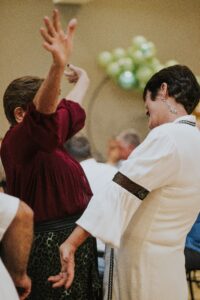 Why Wait?
When faced with a terminal diagnosis, a growing number of people are asking a glaringly obvious question: Why wait?
Researchers at the University of Melbourne are currently tracking this phenomenon through The Living Funeral Project. By interviewing families, celebrants, funeral directors, and end-of-life doulas across Australia, they are charting a rising tide of interest. Families consistently describe these events as profoundly healing, creating a unique space where grief and joy sit comfortably side by side. For the person in the armchair, hearing a lifetime of love expressed and having the chance to speak back, offers a comfort that traditional eulogies simply cannot deliver.
This shift reflects a broader, nation-wide movement toward “death positivity”. Through initiatives like Death Cafés and Death Over Dinner events, Australians are building their “death literacy”, a term tracked by La Trobe University’s Death Literacy Index to measure our collective confidence in navigating mortality.
Even Australia’s $2 billion funeral industry is taking notice. From custom-painted coffins to natural bushland burials, providers are expanding to offer dedicated guidance for those wanting to plan a pre-funeral celebration.
Rewriting the Ending
Organising a living funeral doesn’t require a grand venue or complex logistics. It can be as simple as an intimate dinner party or as big as a neighbourhood bash. The only real pre-requisite is that the person it is for genuinely wants it and is present.
Ultimately, it is about refusing to let your story be told entirely in the past tense. A living funeral offers a rare, generous gift: the chance to clear the slate, say what needs to be said, and feel the full weight of a lifetime’s love while you are still around to enjoy it.